
Who This Is For
Sourcing managers, product developers, and brand owners who need to place OEM packaging orders with a Chinese manufacturer. If you've ever stared at a blank spec sheet wondering whether to write "25x35 cm, 50 micron, 4-color flexo" and have no idea whether the factory will accept it, this guide is for you.
Why Specifying Packaging Correctly Matters
OEM packaging isn't one-size-fits-all. A single parameter error -- writing 0.05mm instead of 0.06mm, using imperial instead of metric units, or omitting the closure type -- can lead to a prototype that doesn't fit your product, a production run that fails drop tests, or a quote missing something you assumed was standard.
Getting the spec right upfront saves time, reduces sample iterations, and keeps your cost on target.
Step 1: Defining Size
Measure your product in its finished state. Packaging should fit the product with a small amount of ease -- enough for smooth loading but not so much that the bag or box looks slack on the shelf.
Common size formats:
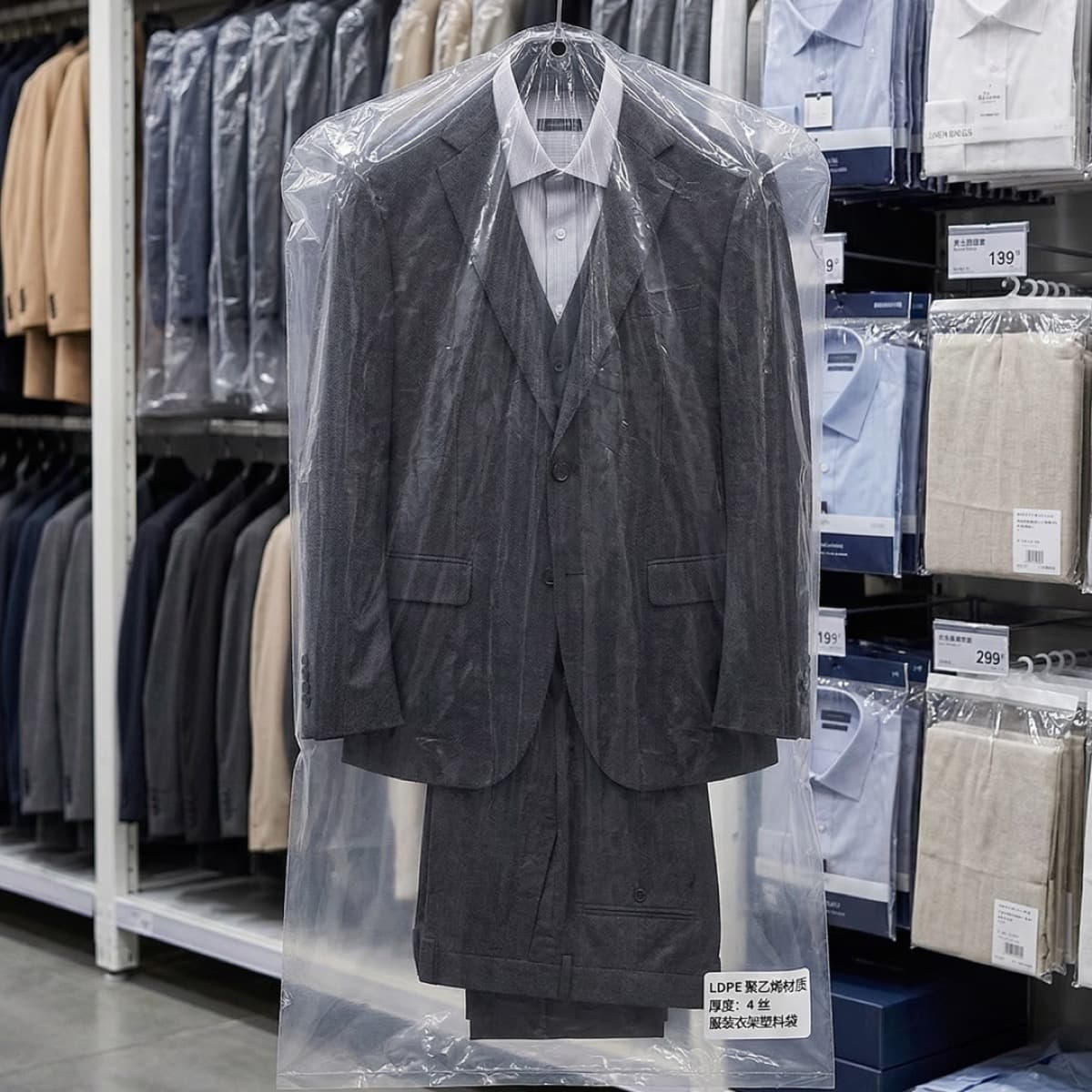
- Garment bags (for suits, dresses, outerwear): Typically measured by full length and bottom width. A standard men's suit bag is 130 cm long x 50 cm wide. For winter coats, allow extra length.
- Mailer boxes (for e-commerce shipments): Measured as Length x Width x Depth (LxWxD). A common apparel mailer is 30x20x6 cm. Factor in padding material and folding method.
- Self-adhesive / slider bags (for accessories, small garments): Measured by width (including side seals) and length. Allow 2-4 cm extra for the seal area.
- Paper gift bags: Measured by height, width, and gusset depth.
Pro tip: Provide the factory with a physical sample or a clear photo with a ruler. Dimension drawings are ideal, but a photograph often catches tolerances the numbers miss.
Step 2: Choosing Thickness and Material
Thickness is one of the most commonly misunderstood parameters in packaging procurement. It determines durability, feel, and unit cost.
Key thickness guidelines for PE-based bags:
| Application | Typical Thickness | Notes |
|---|---|---|
| Ultra-lightweight (accessory bags) | 30-40 micron (0.03-0.04 mm) | Minimal protection; lowest cost |
| Standard garment bags | 40-50 micron (0.04-0.05 mm) | Good balance of cost and durability |
| Heavy-duty / export garment bags | 50-70 micron (0.05-0.07 mm) | Handles rough transit and stacking |
| Rigid boxes (cardstock) | 350-400 gsm | Premium gift packaging |
Material types you'll encounter:
- PE (polyethylene): Most common for garment and shipping bags. HDPE is stiffer and crinklier; LDPE is softer and more flexible.
- Recycled PE (PCR): Post-consumer recycled content. Required for brands with sustainability commitments. Look for GRS (Global Recycled Standard) certification.
- Compostable materials: PLA/PBAT blends for brands targeting certified compostability. Verify end-market acceptance (home compost vs. industrial).
- Glassine: Dense, smooth paper suitable for oil-wax finishes. Excellent moisture barrier for garments in humid environments.
- Kraft paper: Strong, recyclable, widely accepted for e-commerce. FSC-certified options available.
Step 3: Printing Specifications
Color printing on packaging transforms a generic bag into on-brand merchandise.
Printing methods:
- Flexographic (flexo): Industry standard for PE bags. Cost-effective for runs of 1,000+ units. Supports up to 10 colors but 1-4 is most common. Plate cost is a one-time fee; each additional color adds setup cost.
- Digital printing: Best for short runs and full-color artwork (photographs, gradients). No plate fees. Higher per-unit cost; practical for MOQs under 500-1,000.
- Silk-screen: Rare for flexible packaging; only for simple single-color logos on thicker materials.
Color matching:
- Provide Pantone (PMS) codes for brand-critical colors.
- For flexo, the factory creates a CMYK approximation. Request a printed proof before production.
- Metallic or fluorescent inks require separate plates and cost more.
Print area:
- Specify single-sided or double-sided.
- Garment bags are typically single-side print. Mailer boxes can support full-wrap designs.
- Minimum flexo detail resolution: 0.1 mm. Tiny text may not reproduce cleanly.
Step 4: Closure Options
The closure type affects usability and perceived quality:
- Tape-and-peel self-adhesive: Most convenient for e-commerce fulfillment. Requires a release liner.
- Slider / zip closure: Reusable; preferred for retail accessories and small apparel items.
- Heat-seal / open end: Lowest cost; common for bulk garment packaging. Requires a heat-sealer at the buyer's facility.
- Die-cut handle (for paper bags): Key aesthetic feature. Choose between die-cut, rope, or twisted paper handles.
Step 5: MOQ and Lead Time
MOQ varies by product type, customization level, and material:
| Product Type | Typical MOQ Range | Notes |
|---|---|---|
| Standard PE bags (no print) | 5,000-10,000 pcs | Lowest MOQ option |
| Printed PE bags | 3,000-5,000 pcs | Plate cost amortized over volume |
| Mailer / airplane boxes | 1,000-3,000 pcs | Depends on complexity |
| Rigid gift boxes | 500-2,000 pcs | Higher tooling/setup cost |
| Compostable bags | 2,000-5,000 pcs | Material sourcing constraints |
| Glassine garment bags | 3,000-5,000 pcs | Finishing dependent |
Typical lead time: 15-30 days after artwork approval and deposit. Rush orders (7-10 days) carry a premium.
Quote Request Checklist
When reaching out to a supplier, include the following for an accurate quote:
- Product type (garment bag, mailer box, etc.)
- Final dimensions (with tolerance, e.g., +/-2 mm)
- Material type and thickness (recycled content % if applicable)
- Print details: number of colors, Pantone codes, print area, single or double side
- Closure type (tape, slider, heat-seal, handle type)
- Estimated order quantity and reorder frequency
- Special requirements (GRS certification, FSC paper, compostable, etc.)
Related Options on chinapolybags.com
- Color-Printed Apparel Airplane Mailer Box
- White Kraft Self-Adhesive Bag
- Ultra-Thin Glassine Envelope Bag
- Rigid Apparel Packaging Gift Box
Key Takeaway
A well-written spec sheet is the fastest route from idea to finished packaging. Define your dimensions, thickness, material, print, closure, and quantity clearly, and your factory partner can move from quote to production sample efficiently. For brands needing GRS-certified recycled options or FSC-compliant paper products, a manufacturer with multi-certification capabilities -- such as Xiahong Packaging -- can consolidate your packaging supply chain into a single, audit-ready source.
Contact: fly@chinapolybags.com | +86-592-5656669 | Xiamen, China