
---
Who This Is For
Retail buyers, grocery chains, food service operators, and brand managers who need biodegradable packaging that meets food-safe standards while complying with evolving packaging regulations across Europe, North America, and Asia.
This guide is distinct from our compostable mailer article — it focuses specifically on biodegradable thin-film bags for retail, fresh food, produce, deli, and bakery applications, not shipping or postal mailers.
---
Biodegradable vs. Compostable: What Buyers Need to Know
These terms are often used interchangeably in marketing, but they have different technical and regulatory meanings that matter for procurement:
- Biodegradable: A material that breaks down by natural biological processes (microbes, bacteria, fungi) into water, CO2, and biomass. The timeline is not specified — degradation could take months to decades depending on environmental conditions.
- Compostable: A subset of biodegradable materials that decompose within a specific, certified timeframe (typically 90–180 days) under defined conditions (industrial composting at 58°C, or home composting at ambient temperature), leaving no toxic residue.
Why this distinction matters for retail and food packaging:
- EU regulations and consumer protection frameworks increasingly require compostability certification (EN 13432 or ASTM D6400) for any bag marketed as "compostable" or "bio-based."
- A bag labeled "biodegradable" without a recognized certification may not qualify for waste diversion programs or EPR fee reductions.
- Food-contact biodegradable bags must additionally comply with FDA 21 CFR 177.1520 (US) or EU 10/2011 food contact regulations.
---
Recommended Product: Biodegradable PBAT/PLA Blend Film Bags
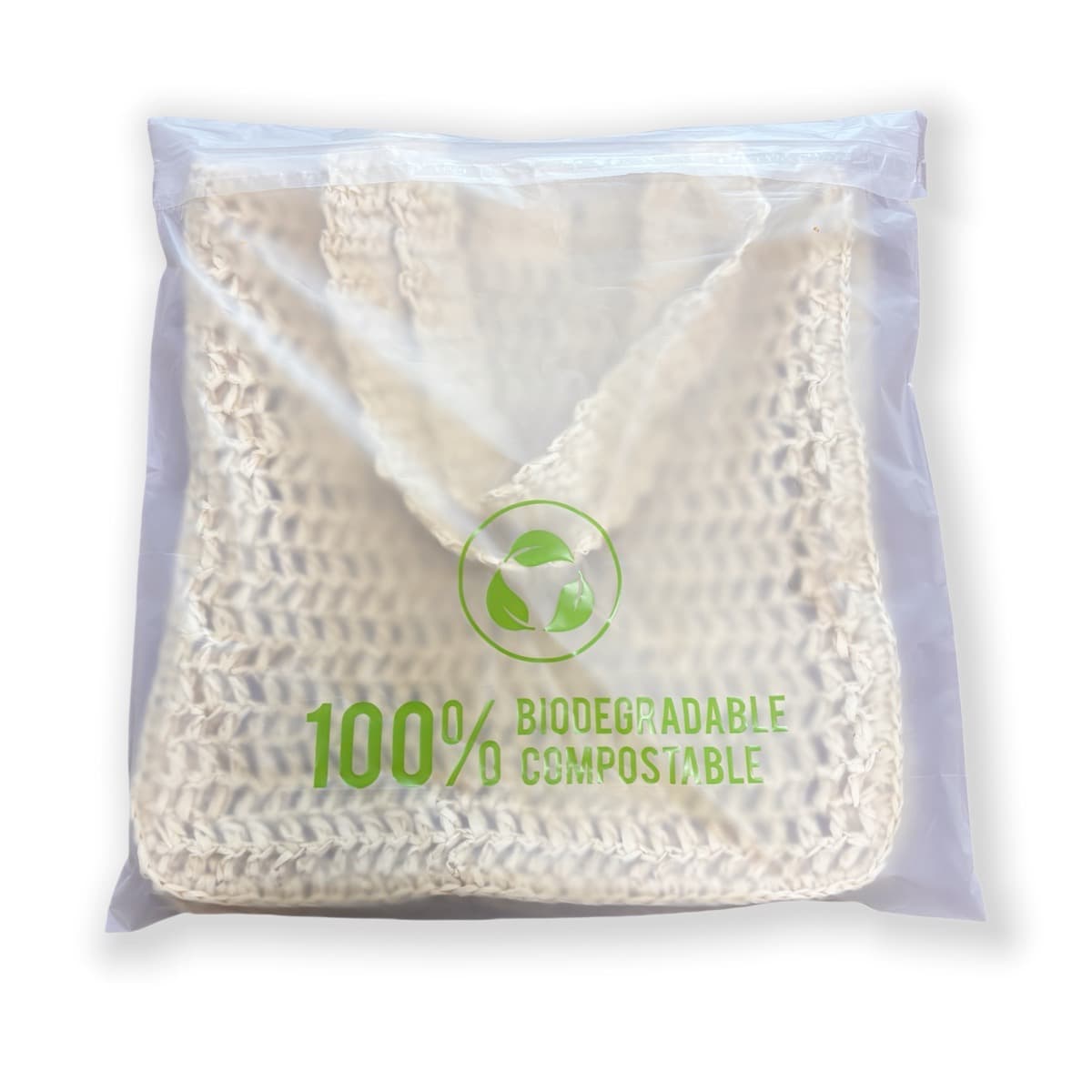
Xiahong Packaging offers biodegradable thin-film bags using a PBAT + PLA + corn starch formulation that meets EN 13432 and ASTM D6400 compostability standards, with food-safe coating options for direct food contact.
Key Specifications
| Parameter | Standard Range | Notes |
|-----------|---------------|-------|
| Material | PBAT/PLA/Starch blend (40/40/20 to 60/30/10 ratios) | PBAT provides flexibility; PLA adds stiffness; starch reduces cost and carbon footprint |
| Certifications | EN 13432 (EU), ASTM D6400 (US), OK Compost INDUSTRIAL (TÜV AUSTRIA) | Food-contact grade available with additional FDA / EU 10/2011 compliance |
| Thickness | 0.015mm – 0.04mm (15–40μ) | Thinner than standard PE bags; requires careful handling for heavy items |
| Print | 1–4 color flexographic (water-based inks recommended) | Bio-based inks available for full compostability chain |
| Closure | Heat-seal, tape-and-peel, open-end | Open-end most common for produce/retail |
| Colors | Natural/cream (unbleached), or custom color | Natural color is standard; tinted options add cost |
| Width range | 10cm to 80cm | Custom cutting; slitting options for high-volume roll stock |
| Degradation timeframe | 90–180 days (industrial composting), 12–24 months (soil/burial) | Varies with environmental conditions and certification standard |
---
Material Comparison: PBAT, PLA, Starch, and Hybrid Blends
Understanding the material trade-offs helps select the right film for your application:
| Property | PBAT | PLA | Starch Blend | PBAT/PLA/Starch Hybrid |
|----------|------|-----|-------------|----------------------|
| Flexibility | Excellent | Brittle at low temp | Good | Good – balanced |
| Tensile strength | 18–22 MPa | 45–55 MPa | 12–18 MPa | 15–25 MPa |
| Clarity/Transparency | Good | Excellent | Moderate | Good |
| Seal integrity | Excellent | Moderate (high seal temp) | Moderate | Good |
| Cost premium vs PE | +80–120% | +60–100% | +40–70% | +50–90% |
| Best use | Heavy retail bags, garment bags | Rigid pouches, windows | Produce bags, lightweight applications | General retail, fresh food |
Recommendation: For retail and food packaging applications, the PBAT/PLA/starch hybrid (50/30/20 ratio) offers the best balance of mechanical performance, cost, and end-of-life credentials.
---
Food-Safe and Food-Contact Considerations
When biodegradable bags are used for direct food contact (produce, deli meats, bakery items, fresh pasta, cheese portions), additional requirements apply:
- FDA 21 CFR 177.1520 compliance – For US market; covers biodegradable polymers for food contact surfaces.
- EU Regulation 10/2011 compliance – For EU market; ensures no migration of harmful substances into food.
- Migration testing – Recommended for all food-grade biodegradable films: total migration ≤ 10 mg/dm², specific migration limits for PLA monomers.
- Antimicrobial coatings – Optional nano-silver or chitosan coatings available for extended fresh produce shelf life (contact supplier for specs).
- Ventilation/perforation – Fresh produce requires controlled O2/CO2 exchange; perforation patterns (2mm holes at 10mm spacing) are available.
---
Ideal Applications
- Fresh produce retail – Fruit, vegetable, herb bags (open-end, perforated)
- Deli and bakery counters – Sandwich, pastry, bread bags (heat-seal, printed)
- Supermarket bulk sections – Nuts, dried fruit, confectionery bags
- Food service takeaway – Salad, noodle, and prepared meal wrapping bags
- Organic/farmers market – Certification-friendly packaging for certified organic producers
- Eco-conscious retail chains – Replace LDPE produce bags in store-wide sustainability programs
- Gift baskets and hamper packaging – Premium biodegradable tissue and outer bags for gifting
---
PPWR Compliance (EU 2025/40)
The EU Packaging and Packaging Waste Regulation (PPWR), which entered into force in 2025, has specific provisions for biodegradable and compostable packaging:
- Article 6: Packaging necessary to meet food safety requirements or for specific applications (such as loose produce) may be exempt from certain reduction targets.
- Article 14: Compostable packaging for loose produce, tea bags, and coffee capsules remains permitted and encouraged — the ban on "unverified" biodegradable plastics does not apply to certified compostable packaging.
- Labeling requirements (Article 23): Must include clear end-of-life instructions, certification logos, and material composition.
- By 2030: All plastic packaging must be recyclable or compostable (where recycling is not technically feasible).
Practical implication: Biodegradable/ compostable bags for fresh produce and loose food items are future-proofed under PPWR — they will not face the phase-out timeline that applies to conventional single-use plastic packaging.
---
Supplier Quote Request Checklist
When requesting quotes for biodegradable retail bags, verify these 10 items:
| # | Verification Item | Why It Matters |
|---|-------------------|----------------|
| 1 | EN 13432 / ASTM D6400 certification (original certificate copy) | Required for waste program eligibility and marketing claims |
| 2 | Food-contact compliance documentation (FDA 21 CFR 177.1520 or EU 10/2011) | Mandatory for direct food packaging |
| 3 | Material composition ratio (PBAT/PLA/Starch %) | Determines cost, flexibility, and certification eligibility |
| 4 | Water-based ink capability | Oil-based inks compromise compostability chain |
| 5 | Perforation / venting options | Critical for fresh produce shelf life |
| 6 | Minimum order quantity (rolls vs individual bags) | Impacts unit economics significantly |
| 7 | Lead time (production) | Biodegradable film production typically 18–28 days |
| 8 | Storage shelf life (before use) | Biodegradable films have shorter shelf life than PE (6–12 months recommended) |
| 9 | Sample delivery timeline | Request before bulk production |
| 10 | End-of-life disposal partnership | Some suppliers help buyers connect with composting facilities |
---
Related Resources
- Biodegradable Bags Product Page
- Our Certifications (GRS, FSC, Sedex)
- Apparel & Retail Packaging Solutions
---
Key Takeaway
For retailers and food service operators transitioning away from conventional LDPE, biodegradable PBAT/PLA/starch blend bags offer a near-drop-in replacement with verified end-of-life credentials. With EN 13432 and ASTM D6400 certification, food-safe options, and PPWR compliance, they are the most practical sustainable alternative for fresh food and produce packaging today.
Xiahong Packaging supports full OEM customization, food-grade biodegradable film production, and multi-certification programs. Contact us at fly@chinapolybags.com or +86-592-5656669 for samples, material data sheets, and volume-based quotes.