
Anti-Static Poly Bags for Electronic Component Packaging: A Complete B2B Buyer's Guide
Target Audience: Electronics manufacturers, PCB assembly houses, semiconductor distributors, component traders, and procurement teams seeking ESD-safe packaging to protect sensitive components during storage, transport, and handling.
---
Why ESD-Safe Packaging Is Non-Negotiable for Electronics
Electrostatic discharge (ESD) causes silent, cumulative damage to electronic components that may not manifest until months after shipment. A single static spark — invisible and inaudible — can degrade semiconductor junctions, corrupt memory cells, or create microscopic cracks in silicon die. The cost of a single recalled lot of damaged ICs often exceeds the annual packaging budget.
ESD regulations (IEC 61340-5-1, ANSI/ESD S20.20, MIL-PRF-81705) are no longer optional for electronics supply chains. Major OEMs, contract manufacturers, and distributors enforce ESD-compliant packaging as a gating requirement for supplier qualification. Using the wrong bag — plain PE instead of anti-static — risks component failure, warranty claims, and lost contracts.
Anti-static poly bags provide the simplest, most cost-effective layer of component protection: a thin plastic pouch that prevents static charge accumulation on its surface while offering basic moisture and dust barrier. When spec'd correctly, they protect components from manufacture through final assembly at a cost of pennies per bag.
---
What Are Anti-Static Poly Bags?
Anti-static poly bags are plastic pouches manufactured from polyethylene (PE) film treated with an internal antistatic additive. Unlike conductive or dissipative bags (which actively bleed charge to ground), anti-static bags primarily prevent static charge buildup on their surface — keeping the surface resistance in the range of 10^9 to 10^12 ohms/sq. This is sufficient for most consumer electronics, passive components, and PCBs.
Three protection tiers in the anti-static family:
| Type | Surface Resistance | Color | ESD Rating | Typical Use |
|------|-------------------|-------|------------|-------------|
| Anti-Static (Clear) | 10^9 – 10^12 ohms/sq | Transparent | ESD-safe | Passives, PCBs, consumer electronics |
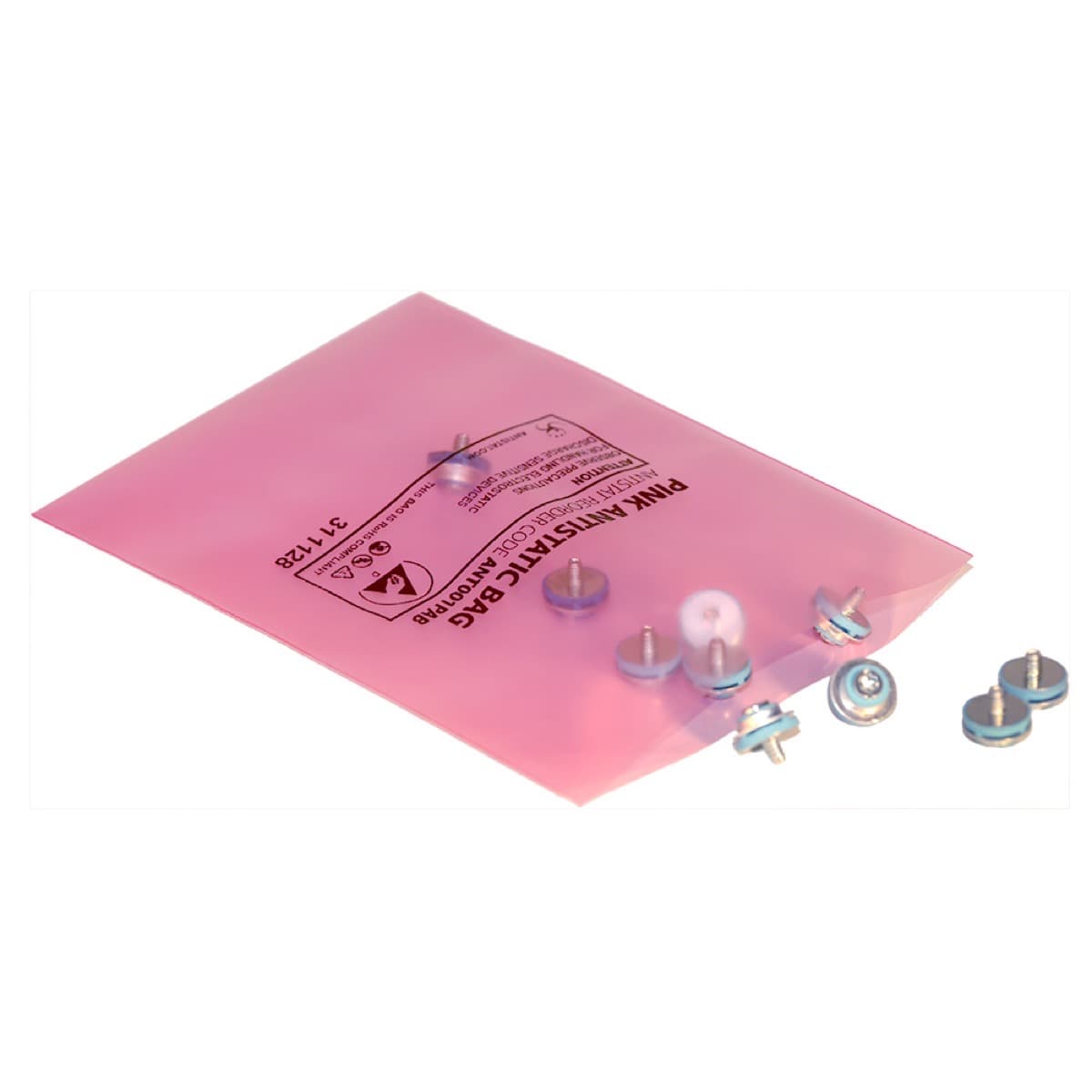
| Dissipative (Pink) | 10^6 – 10^9 ohms/sq | Pink | ESD-sensitive (ESDS) | ICs, MOS devices, semiconductor components |
| Conductive (Metallic/Black) | <10^6 ohms/sq | Silver-black, dark gray | ESD shielding | Sensitive RF modules, aerospace-grade semiconductors |
Xiahong Packaging specializes in anti-static clear PE bags and dissipative pink poly bags, which together cover approximately 85% of electronic component packaging needs in consumer and industrial electronics.
---
Key Specifications for B2B Buyers
| Parameter | Typical Range | Notes |
|-----------|--------------|-------|
| Material | LDPE with antistatic additive | Internal treatment — additive migrates to surface |
| Surface Resistance | 10^9 – 10^12 ohms/sq (anti-static); 10^6 – 10^9 ohms/sq (dissipative) | Verified by 4-point probe or surface resistometer per IEC 60093 |
| Thickness | 35 – 100 µm | 35-50 µm for light components; 75-100 µm for heavy PCBs |
| Bag Width | 50 – 500 mm | Custom sizes to the millimeter |
| Bag Length | 75 – 600 mm | Gusset depth 30–80 mm for bulk component quantities |
| Closure Type | Heat-seal, peel-and-seal (pressure-sensitive adhesive), open | Peel-and-seal preferred for repeated opening; heat-seal for tamper evidence |
| Surface Finish | Matte or glossy | Matte surface preferred for print adhesion and reduced static tendency |
| Additional Features | Hole punch, hanging tab, zip-lock, perforation tear notch | Hole punch for peg display in retail/electronics distribution |
| Print Option | Flexographic, 1–4 colors | Branding, warnings (ESD symbol), batch numbers, barcodes |
| Certification | IEC 61340-5-1, ANSI/ESD S20.20, ISO 9001 | Test reports available upon request |
| Lead Time | 15–25 days | Faster for standard sizes; longer for custom printing |
---
Recommended Applications by Component Type
1. Integrated Circuits (ICs, Microcontrollers, Memory)
Recommended: Dissipative pink poly bags, 35–50 µm, peel-and-seal closure.
Pink film provides visual confirmation of ESD-protected packaging. Peel-and-seal allows technicians to retrieve individual bags from a larger carton without breaking the seal on the entire lot. Width: 100–200 mm; Length: 150–250 mm.
2. Printed Circuit Boards (PCBs, Bare and Assembled)
Recommended: Anti-static clear PE bags, 75–100 µm, heat-sealed.
Thicker gauges prevent puncture and tearing during stack storage. Clear film allows visual inspection of board silk-screen and component placement without opening. Width: 200–400 mm; Length: 250–450 mm, with 40–80 mm side gusset.
3. Passive Components (Resistors, Capacitors, Inductors)
Recommended: Anti-static clear PE bags, 35–50 µm, open-end (for bulk reel packaging) or peel-and-seal.
Small-size bags (50×75 mm to 100×150 mm) for individual component count. For reel/tape-and-reel packaging, open-end bags serve as over-bags to protect reels during shipping.
4. Semiconductor Wafers and Dies
Recommended: Dissipative pink or conductive metallic bags, 50–75 µm, heat-sealed with double seam.
Higher protection tier for bare silicon. Double-sealed edges prevent static migration. Often used in conjunction with desiccant packs and humidity-indicator cards inside the bag.
5. LED Modules and Optoelectronics
Recommended: Anti-static clear bags with UV-blocking additive, 50–75 µm.
LEDs and laser diodes are sensitive to both ESD and UV exposure. UV-blocking clear film provides dual protection while maintaining visibility for visual inspection.
6. Connector and Cable Assemblies
Recommended: Anti-static clear bags, 50–75 µm, peel-and-seal, with hole punch for retail display.
Allows point-of-sale or distributor display while maintaining ESD protection. Width: 80–150 mm; Length: 120–200 mm.
---
Anti-Static Poly Bags vs. Competing Formats
| Feature | Anti-Static PE Bag | Metal-In-Shield (MIS) Bag | Conductive Pouch | Static-Charging PE Bag |
|---------|-------------------|--------------------------|-----------------|----------------------|
| ESD Protection Level | Moderate (charge prevention) | Excellent (Faraday cage) | High (charge dissipation) | None (generates static) |
| Moisture Barrier | Basic (PE only) | Excellent (aluminum foil) | Moderate | Basic |
| Transparency | High (clear bags) | Opaque | Semi-transparent to opaque | High |
| Cost per Unit | $0.02 – $0.15 | $0.15 – $1.50 | $0.05 – $0.30 | $0.01 – $0.05 |
| Visibility Without Opening | Yes | No | No | Yes |
| Print Quality | Good (flexo) | Poor (foil surface) | Moderate | Good |
| Typical Use Case | General component protection | Highly sensitive RF/military components | Semiconductor handling | General-purpose (NOT ESD-safe) |
---
10-Point Verification Checklist for Buyers
Before placing a bulk order, verify the following with your supplier:
- Surface resistance test report — Request a current test report (≤12 months old) from an accredited lab, measured per IEC 60093 or ASTM D257; confirm readings fall within the claimed range
- ESD symbol certification — Verify the electrostatic discharge symbol is correctly printed (ANSI/ESD S20.20 format: hand inside triangle with diagonal line)
- Thickness tolerance — Confirm ±10% or tighter; thinner bags risk puncture during PCB handling
- Peel-and-seal adhesive durability — Confirm adhesive maintains ≥5 N/25mm peel strength after 72-hour humidity exposure (85°C/85% RH or 60°C/90% RH)
- Antistatic additive permanence — Ask whether the antistatic treatment is internal (migration-based, lasts 1–3 years) or external (coating-based, may wash off); internal treatment is preferred for long-term storage
- Compatibility with desiccants — Confirm the bag does not react with silica gel or molecular sieve desiccant packs stored together
- Seal integrity — Heat-sealed bags should pass a 1-meter drop test from 1.5 meters with 2 kg load; no delamination at seal
- Print fastness on antistatic surface — Confirm ink adhesion does not flake during handling; antistatic additives can interfere with ink bonding
- MOQ and sampling — Confirm minimum order quantities and availability of free sample packs for ESD testing before bulk commitment
- Batch traceability — Verify lot-number printing or batch-code marking for supply-chain traceability, especially for automotive or medical electronics
---
Internal Resources
- Plastic Bags Product Catalog
- ESD-Safe Packaging Solutions
- Custom Packaging Capabilities
- Electronics Packaging Solutions
---
About Xiahong Packaging
Xiamen Xiamen Xiahong Plastic Products Co., Ltd. has been manufacturing custom packaging since 2007, with dual production facilities in Fujian and Guangdong provinces. Our anti-static bag production lines are certified under ISO 9001, ISO 14001, and Sedex/SMETA, with ESD-specific compliance to IEC 61340-5-1 and ANSI/ESD S20.20 standards.
We offer full OEM capabilities — custom sizes, film thickness, antistatic/dissipative/conductive grades, closure types, printing designs, and certification documentation — with MOQ flexibility for pilot orders and large-scale production runs.
Need ESD-safe packaging for your electronic components? Contact our team for a free consultation, material samples, and a competitive quote.