
Oil-Wax Glassine Bags for Moisture-Sensitive Garments: A Sourcing Guide for Apparel Exporters
Published by Xiahong Packaging Team / 夏宏包装团队
---
Who This Is For
Sourcing managers, packaging engineers, and quality teams at apparel exporters and knitwear brands — particularly those shipping woolens, cashmere, underwear, hosiery, scarves, and down-filled garments through humid shipping seasons or long ocean transits. If your returns file contains photos of water spots, dye transfer, or a musty "closed container smell" on garments that left the factory in perfect condition, this guide is for you.
---
The Real Enemy Is Condensation, Not Rain
Most garment moisture damage does not happen in a storm. It happens in a sealed container. During ocean transit, interior temperature swings cause water vapor to condense on the container walls and ceiling — a phenomenon logistics teams call "container rain." Drops fall directly onto cartons, and relative humidity inside the pack can climb well past 80–90% for days. At sustained high humidity, mold can establish on natural fibers within a matter of days, and residual moisture trapped in a sealed poly bag turns into visible condensation against the garment itself.
Conventional answers each carry a trade-off:
- PE poly bags block external water, but they also trap the garment's own residual moisture and generate static. They are also under increasing regulatory scrutiny in Europe.
- Plain tissue or interleaf paper cushions and absorbs briefly, but offers no grease or water resistance and adds a manual packing step.
- Desiccants and anti-mold strips help at the carton level, but they do nothing for direct garment contact — and they are easy to skip or under-dose in high-volume packing lines.
The EU Packaging and Packaging Waste Regulation (PPWR), which takes full effect in 2026, sharpens the calculus: packaging must avoid excessive weight and volume, carry an EU Declaration of Conformity, and progressively phase down certain single-use plastic formats. Non-compliant packaging can be pulled from the market with fines attached. For garments destined for the EU, a paper-based protective layer is no longer just a nice-to-have — it is a compliance strategy.
---
Recommended Product: Oil-Wax Glassine Garment Bags
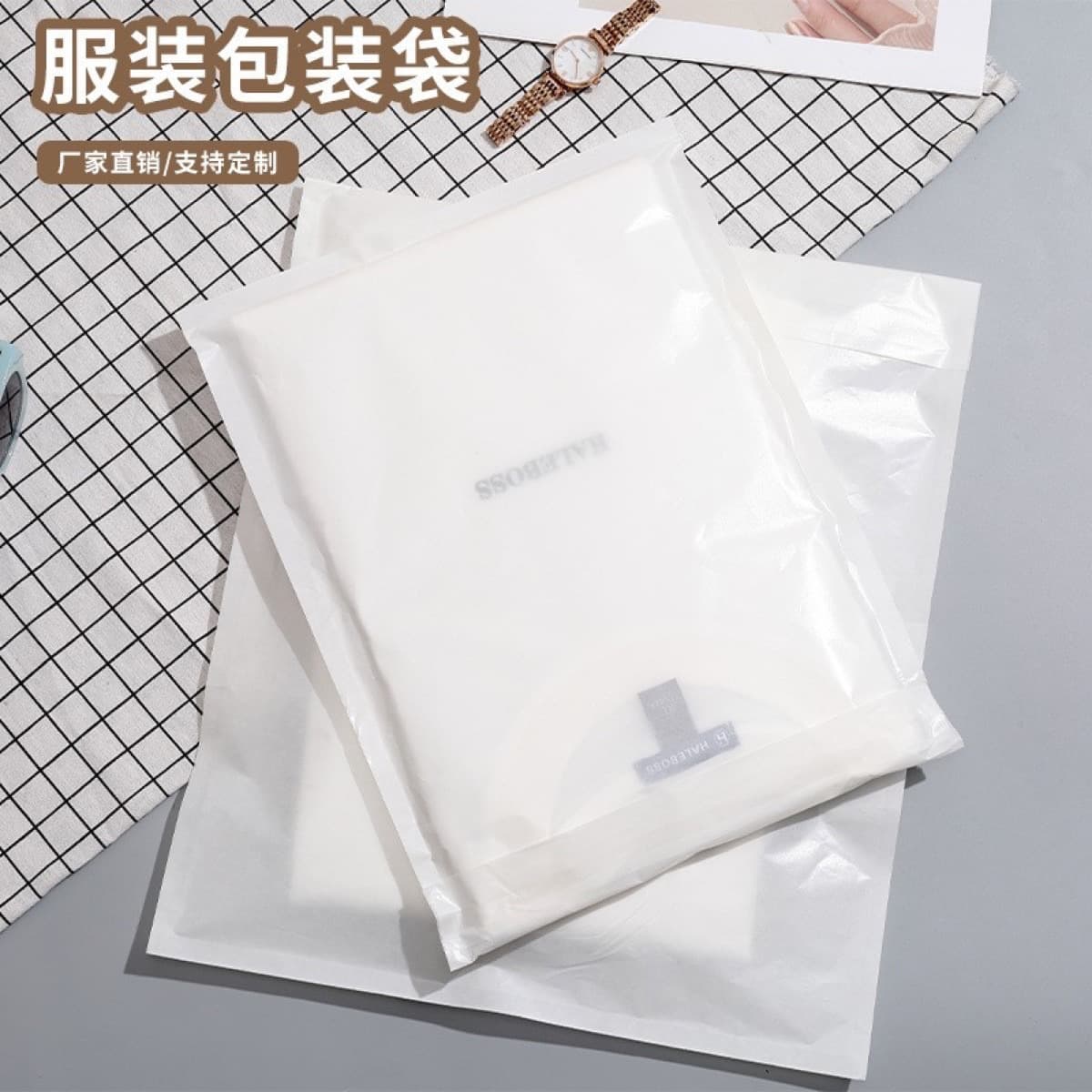
Xiahong Packaging (夏宏包装) produces semi-transparent oil-wax / glassine garment bags in self-adhesive and resealable formats — a plastic-free protective layer for moisture- and oil-sensitive garments, with stock sizes and custom logo printing available.
What "Glassine" Actually Means
Glassine is not coated paper. It is made by super-calendering — pressing a dense wood-pulp sheet through heated rollers under extreme pressure until the fibers fuse into a smooth, translucent, low-porosity surface. The result is naturally resistant to grease and moisture, without waxes or plastic coatings that can migrate onto garments. The "oil-wax" grade adds an oil- and water-resistant treatment for tougher conditions: denim dye rub-off, down-proof feather oils, tailoring residues, and cosmetic traces.
A frequent buyer question in the Chinese supply chain is the difference between glassine bags (格拉辛纸袋) and waxed paper bags (蜡光纸袋): traditional paraffin-waxed papers can bloom, mark, or stain garments under heat and pressure, while super-calendered glassine keeps a dry, clean surface. For garment contact, that distinction matters.
Key Specifications
| Attribute | Detail |
|-----------|--------|
| Material | Virgin wood-pulp glassine, super-calendered; oil-wax grade for oil/grease resistance |
| Grammage | 35–50 GSM standard; lighter or heavier weights on request |
| Appearance | Semi-transparent — hangtags, barcodes, and colorways readable without opening |
| Resistance | Oil and grease resistant (Kit grade on request), water-repellent surface |
| Closure | Self-adhesive strip (peel-and-seal) or resealable format |
| Sizes | Stock sizes for standard garment formats; fully custom dimensions |
| Printing | Flexo 1–2 color logo or artwork |
| Certifications | FSC chain of custody available; GRS, ISO 9001/14001, Sedex-audited production |
| End of life | Fiber-based, biodegradable and compostable grades available; EU PPWR-aligned documentation support |
---
Where Oil-Wax Glassine Bags Earn Their Cost
- Knitwear and cashmere. Individually sleeved garments resist lint, dye migration, and surface moisture during 30–45 day transits; the paper breathes where sealed PE traps.
- Underwear, intimates, and hosiery. A hygienic, tear-open inner layer that reads as premium at retail and replaces two-step tissue-plus-poly packing with one action.
- Down and padded jackets. The oil-wax barrier resists feather-tip oil marks — a classic QC complaint on light-colored shell fabrics.
- Denim and dark-color goods. Reduced dye rub-off onto cartons, hangers, and neighboring SKUs.
- Retail-ready presentation. Translucency gives the visual merchandising benefit of a poly bag with a fiber-based profile, supporting sustainability claims without losing product visibility.
On high-volume lines, the self-adhesive flap removes a manual folding step: packer lays the garment in the sleeve, peels, and seals.
---
Quote Checklist (10 Points to Confirm Before Sampling)
- Garment type, fiber content, and packed weight per piece
- Folded dimensions — and whether the bag carries a hangtag or fold-over card
- Target grammage and transparency (35 / 40 / 50 GSM)
- Closure type: self-adhesive strip or resealable
- Required oil/grease test method and pass level (e.g., Kit grade, buyer QC protocol)
- Printing: logo colors, position, artwork format
- Certification claims to be printed (FSC license code, compostability mark)
- Destination market and any PPWR / Declaration of Conformity documentation needed
- Quantity, bundling (e.g., 100 pcs per bundle), and Incoterms
- Sample schedule and pre-shipment inspection criteria
---
Related Resources
- Paper bag and paper-based formats: /catalog/paper-bags
- Apparel brand packaging programs: /solutions/apparel-brand-packaging
- Paper packaging solutions overview: /solutions/paper-packaging
- Factory capabilities (established 2007, dual factories in Xiamen and Zhangzhou, FSC / GRS / Sedex / ISO 9001 / ISO 14001): /capabilities
---
Next Step
If moisture, dye transfer, or plastic-reduction targets are on your packaging agenda this season, start with a dimension pull from your three best-selling garment SKUs and request oil-wax glassine samples in those sizes. Our team can match grammage, Kit grade, and closure to your transit profile and print your logo in a single line. Reach us via /contact for a quote package with sample schedule.