
Who This Is For
Apparel exporters, private-label clothing brands, and lingerie manufacturers who ship finished garments in protective packaging to retail distributors across Europe, North America, and beyond. If your customers demand moisture-resistant garment protection that meets evolving sustainability regulations, this product is for you.
This article is especially relevant for procurement managers at mid-to-large apparel brands (annual order volume 50,000+ pieces) who are balancing cost efficiency with compliance requirements for the EU and US markets. It also serves packaging engineers evaluating alternative materials to replace traditional PE garment bags.
The Problem Moisture Protection Solves
Garments in transit face multiple humidity threats: container condensation, coastal shipping in tropical climates, and warehouse storage in variable-temperature environments. When moisture penetrates standard PE garment bags, it leads to musty odors, mildew spots on fabric, and customer complaints — all of which erode brand trust and trigger costly returns.
A single container load of mixed-season apparel shipped through Southeast Asian waters can experience relative humidity levels exceeding 90% inside the container. Over a 14-21 day sea voyage, this creates a greenhouse effect where the temperature differential between the container's steel walls and the ambient air generates condensation — water droplets that settle directly on packaged garments.
Plastic-only alternatives are increasingly scrutinized by European buyers under the EU Packaging and Packaging Waste Regulation (PPWR), Regulation (EU) 2025/40, which mandates recyclability requirements and reduced virgin plastic use starting in 2025. Brands that fail to transition to compliant packaging risk supply chain disruption when retailers enforce their own sustainability mandates.
Recommended Product: Oil-Wax Glassine Garment Bags
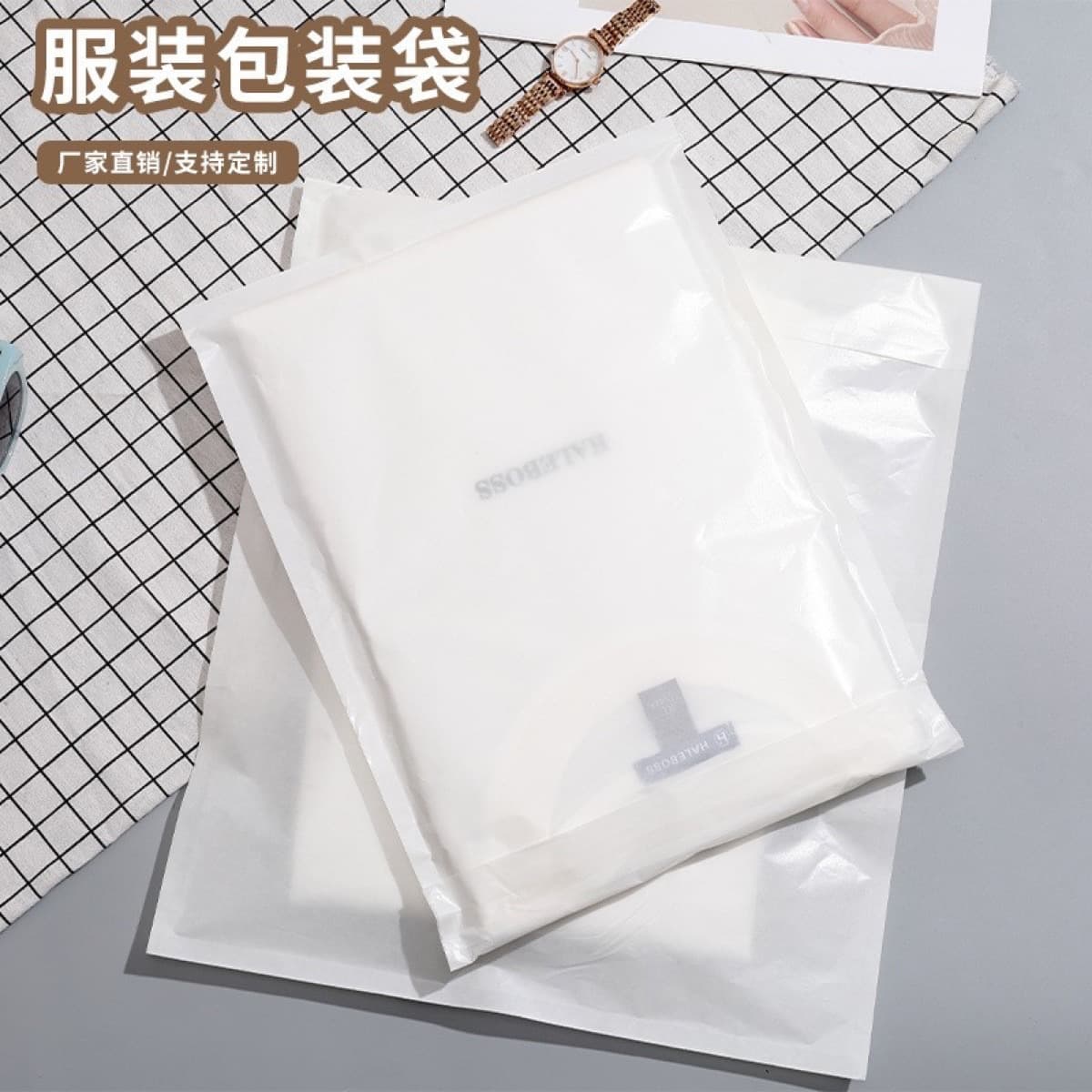
Oil-wax glassine garment bags combine the natural moisture and oil resistance of glassine paper with a protective wax coating, delivering a biodegradable packaging solution that meets both functional and sustainability requirements. The material is fully compostable under industrial conditions and breaks down significantly faster than conventional plastic alternatives in landfill environments.
Key Specifications:
- Material: Oil wax paper / glassine (biodegradable, grease-resistant)
- Closure Options: Self-adhesive flap or zipper closure
- Stock Sizes: 15x17+5 cm to 40x50+5 cm (covers most apparel categories)
- Opacity: Translucent to semi-opaque depending on GSM
- Print: Custom logo printing available on request
- Compliance: EU PPWR compliant (Regulation (EU) 2025/40); GRS certified production lines available
Why Glassine Works for Garments:
Glassine is a smooth, glossy paper produced by supercalendering — a process that densely packs cellulose fibers to create a naturally non-porous surface. Unlike plain kraft or standard tissue paper, glassine is inherently air-, water-, and grease-resistant without requiring additional plastic laminates. The oil-wax coating adds an extra layer of hydrophobic protection, making it ideal for garments that need long-term storage and transit durability.
The translucent quality of glassine also provides a practical advantage: buyers can identify the garment inside the bag without opening it, improving warehouse efficiency during sorting and distribution. This is particularly valuable for retailers managing large SKU counts.
Applications
- Ready-to-wear apparel — shirts, dresses, trousers, and jackets shipped directly to retail
- Lingerie and intimate apparel — where moisture protection is critical for hygiene and presentation
- Accessories — scarves, belts, and small leather goods stored in humid environments
- High-end fashion brands — brands that require premium unboxing experiences with sustainable packaging
- Export shipments — ocean freight and multi-modal logistics through high-humidity regions
- Winter clothing — down jackets and heavy outerwear that benefit from moisture barrier protection during long-term warehouse storage
What to Ask Your Supplier (Quote Checklist)
When requesting a quote for oil-wax glassine garment bags, confirm the following:
- GSM range and thickness tolerance — typical range is 50-90 g/m2 for garment applications
- Adhesive type — pressure-sensitive self-adhesive with adequate initial tack and long-term hold
- Wax coating consistency — uniform oil-wax distribution to prevent weak spots
- Closure strength test results — especially for zipper variants under tension
- Sustainability documentation — biodegradability test reports, GRS chain-of-custody certificates
- EU PPWR compliance proof — test reports and declarations for recyclability and recycled content targets
- MOQ for custom printing — minimum order quantity for logo printing on glassine
- Lead time for stock vs. custom sizes — stock sizes ship faster; custom sizes require tooling
- Sample availability — always request physical samples before placing bulk orders
- Packaging quantity per master carton — for accurate freight cost calculation
Related Products
- Ultra-Thin Glassine Envelope Bags — for small accessories and delicate items
- GRS Recycled Garment Bags — when 100% recycled PE is preferred
- Biodegradable Garment Bags — compostable alternatives for eco-forward brands
Soft CTA
Xiahong Packaging manufactures oil-wax glassine garment bags in Xiamen, China, with stock sizes ready to ship and custom printing available. Our production lines operate under GRS certification, and we provide full EU PPWR compliance documentation for every order. If you are sourcing moisture-resistant, biodegradable garment packaging for your next production run, request a factory quote today.