
---
Who This Is For
Apparel exporters, private-label fashion brands, and sourcing managers targeting European Union markets who need to align packaging procurement with tightening environmental regulations while controlling unit costs.
The Regulatory Landscape in 2025–2026
The EU has accelerated its packaging sustainability agenda. The Packaging and Packaging Waste Regulation (PPWR), now finalised, mandates minimum recycled content across all plastic packaging categories by 2030 — with interim targets already in effect. Simultaneously, Extended Producer Responsibility (EPR) schemes in Germany, France, and the Nordics require brands to register, report, and pay fees based on packaging volume and material type.
For garment exporters, this means:
- Virgin plastic polybags face rising EPR fees in key markets, with France's ECO-EMBALLAGES charging up to €1,100 per tonne for non-recycled PE in the apparel category.
- GRS-certified recycled bags qualify for reduced or exempted EPR rates in multiple jurisdictions — a direct cost savings that scales with volume.
- The EU's Deforestation Regulation (EUDR) and single-use plastic directives add further pressure on supply chains that still rely on unverified packaging.
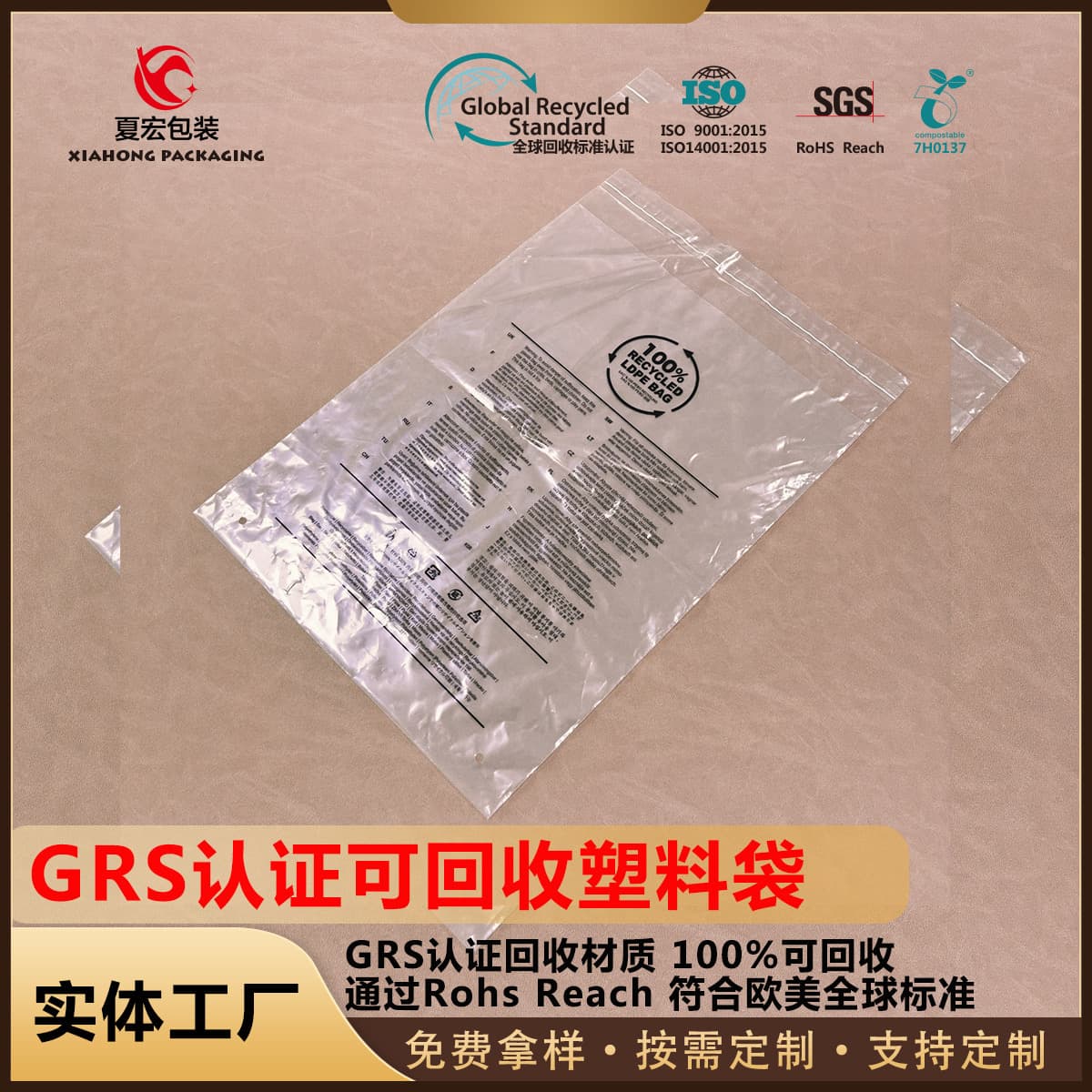
Recommended Product: GRS Certified Recycled PE Garment Bags
Global Recycled Standard (GRS) certification is the most widely accepted framework for verifying recycled content in packaging. Unlike self-declared claims, GRS requires chain-of-custody documentation, third-party audits, and transaction certificates (TCs) for every shipment — making it the gold standard for EU market compliance.
#### Key Specifications
| Parameter | Standard Range | Notes |
|-----------|---------------|-------|
| Material | 30%–100% PCR PE (Post-Consumer Recycled) | Multi-tier sourcing strategy recommended |
| Certification | GRS (v4.0+) + C-TPAT | GRS covers content; C-TPAT covers supply-chain security |
| Thickness | 0.03mm – 0.06mm (30–60μ) | Thinner gauges reduce material cost and weight |
| Print | 1–6 color flexographic or digital | Recycled PE has a slight grey undertone |
| Closure | Tape-and-peel, heat-seal, slider | Tape-and-peel most common for garment bags |
| Size range | Custom from 20×30cm to 70×100cm | OEM sizing with 2mm tolerance |
Multi-Tier Recycled Content Strategy
Not every SKU needs 100% recycled content — a tiered approach balances compliance, cost, and brand positioning:
| Tier | Recycled Content | Best Use Case | Cost Premium vs Virgin |
|------|-----------------|---------------|----------------------|
| Standard | 30% PCR | Economy / unbranded inner bags | +5–8% |
| Eco | 50% PCR | Mid-tier brands, seasonal lines | +10–15% |
| Premium | 100% PCR | Luxury, sustainability-led brands | +20–30% |
Why this works: You can use 30% PCR for bulk shipping bags (where the bag is hidden inside a carton) and 100% PCR for outer retail-facing garment bags (where sustainability claims are visible on the product and marketing). This approach can reduce overall packaging cost impact by 40–60% compared to going 100% across the board.
Cost-Benefit Snapshot
| Metric | Virgin PE Bag | 50% GRS PCR Bag | 100% GRS PCR Bag |
|--------|-------------|-----------------|-------------------|
| Baseline cost | €0.012/unit | €0.014/unit | €0.015/unit |
| EPR fee (France, apparel) | ~€0.0011/unit | ~€0.0006/unit | ~€0.0002/unit |
| Net unit cost | €0.0131 | €0.0146 | €0.0152 |
| Carbon footprint | 1.0x baseline | ~0.5x baseline | ~0.35x baseline |
Note: EPR fees vary by country and annual volume negotiated with eco-organism. Figures are indicative for 100g garment bags, 50,000-unit annual volume.
Ideal Applications
- European apparel exports — T-shirts, blouses, dresses shipped from Asian factories to EU distribution centers
- Private-label fashion — Brands selling through Amazon EU, Zalando, ASOS, or their own DTC storefronts
- Sustainability-led product launches — Collections marketed as "recycled packaging" or "plastic-neutral"
- EPR-registered brands in France, Germany, Belgium, Netherlands — Where packaging fees directly impact COGS
- B2B wholesale garment distribution — Suppliers packaging for multiple retail accounts across Europe
Supplier Quote Request Checklist
When requesting quotes for GRS recycled garment bags, verify these 10 items:
| # | Verification Item | Why It Matters |
|---|-------------------|----------------|
| 1 | GRS Transaction Certificate (TC) available per shipment | Required for EU EPR reporting and customer audits |
| 2 | Recycled content percentage (30/50/70/100%) | Determines EPR fee rate and marketing claims |
| 3 | Third-party audit report (Intertek, SGS, or equivalent) | Confirms GRS certification is current and valid |
| 4 | C-TPAT compliance | Required for US imports; increasingly asked by EU retailers |
| 5 | Print color matching tolerance | PCR has natural colour variation; confirm acceptable delta-E |
| 6 | Thickness tolerance (±μ) | Garment bags often need thin gauges for cost control |
| 7 | MOQ per color/design | Impacts flexibility for seasonal SKU rotations |
| 8 | Lead time (production + shipping) | Typically 15–25 days production + 25–35 days sea freight |
| 9 | EPR registration support | Some suppliers help with eco-organism registration |
| 10 | Sample availability | Always request physical samples before bulk production |
Related Resources
- GRS Garment Poly Bags Product Catalog
- Apparel Packaging Solutions
- Our Certifications (GRS, FSC, Sedex)
Key Takeaway
For apparel exporters shipping to the EU, GRS-certified recycled PE garment bags are no longer optional — they're a cost-control tool. The combination of reduced EPR fees, compliance with PPWR targets, and consumer-facing sustainability credibility makes them one of the highest-ROI packaging upgrades available today.
Xiahong Packaging holds active GRS, FSC, and Sedex certifications and supports full OEM customization. Contact us at fly@chinapolybags.com or +86-592-5656669 to request GRS-certified samples and a volume-based quote.