
---
Who This Is For
Electronics manufacturers, semiconductor packaging lines, PCB assembly houses, and consumer electronics brands that require ESD-safe (electrostatic discharge) packaging to protect sensitive components during manufacturing, storage, and shipping.
Recommended Product: Anti-Static (ESD-Safe) Poly Bags
Anti-static bags — also called ESD-safe bags or dissipative poly bags — are the industry-standard packaging solution for electrostatic-sensitive electronic components. These bags prevent the buildup and discharge of static electricity, which can damage microchips, PCBs, LEDs, and other sensitive electronics that are invisible to the naked eye but highly vulnerable to voltage spikes as low as 30 volts.
This guide explains when you need ESD-safe bags, how to specify them correctly, and common pitfalls that compromise component protection.
---
1. Why Anti-Static Packaging Matters for Electronics
Static electricity is one of the most overlooked threats in electronics manufacturing and logistics. A single electrostatic discharge event can:
- Permanently damage ICs and microprocessors — often creating latent defects that fail only weeks or months after shipment
- Degrade MOSFET gate oxides — reducing component lifespan without visible signs
- Destroy LED arrays and sensor modules — particularly in automotive and aerospace applications
- Compromise memory chips — causing intermittent failures that are expensive to trace
The cost of ESD-safe packaging is a tiny fraction of the cost of a product recall, warranty claim, or brand reputation damage caused by field failures.
---
2. Types of Anti-Static Bags
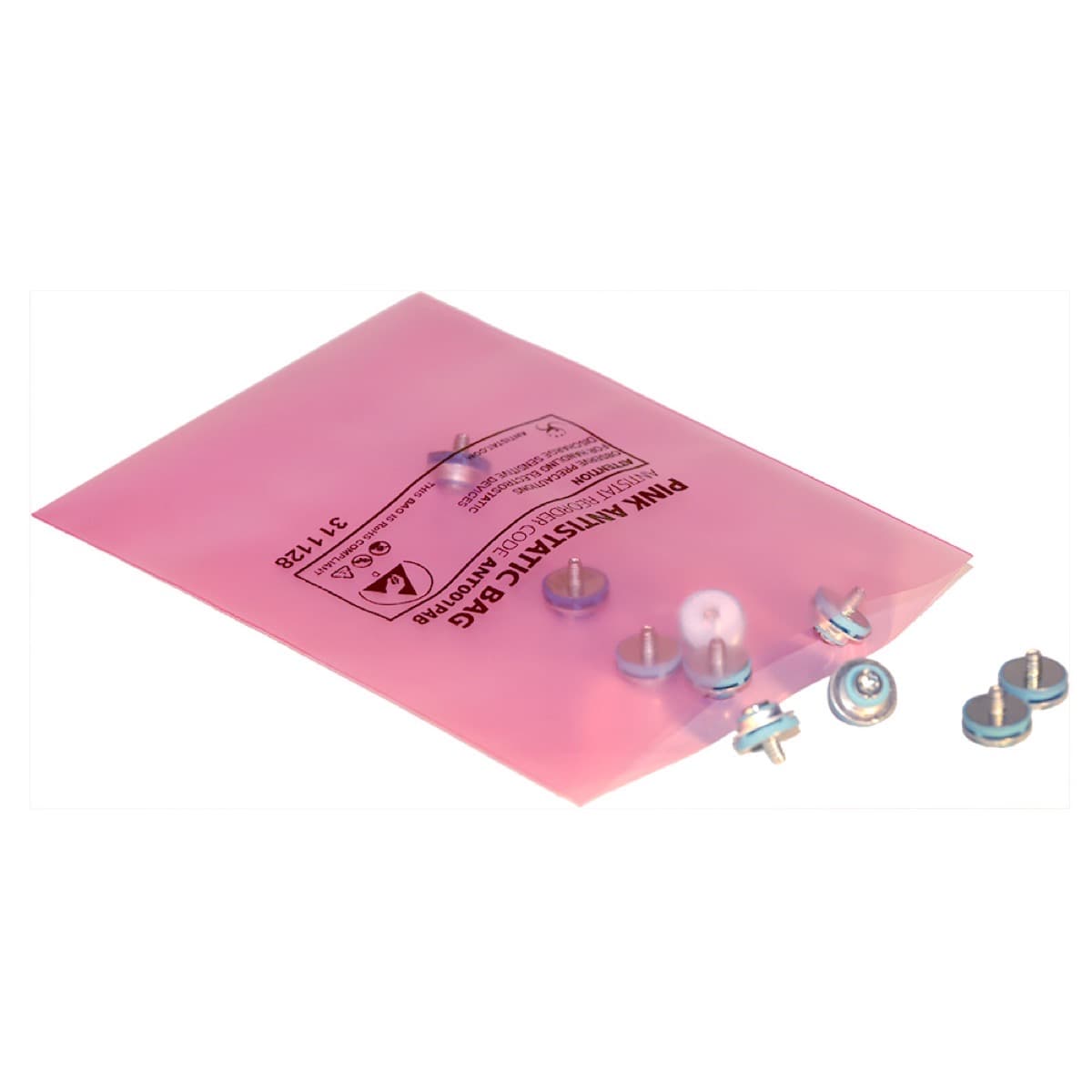
Pink Poly Bags (Static-Dissipative)
- Material: HDPE with antistatic additives
- Surface Resistivity: 10⁹ – 10¹¹ ohms/sq
- Appearance: Light pink/translucent
- Use Case: General electronics assembly, PCB handling, component storage
- ESD Protection: Moderate — reduces static buildup but does not shield from external ESD events
- Cost: Lowest tier of ESD packaging
Metallic Shielding Bags (Silver/Metallic)
- Material: Multiple layers (PET/aluminum/PE) with Faraday cage effect
- Surface Resistivity: < 10⁶ ohms/sq (conductive outer)
- Appearance: Shiny silver metallic finish
- Use Case: High-value ICs, microprocessors, memory modules, PCBs
- ESD Protection: Full shielding — blocks both internal discharge and external ESD fields
- Color Coding: Pink for dissipative, silver for shielding
Clear Conductive Bags (PET-based)
- Material: Biaxially oriented PET (BOPET) with conductive coating
- Surface Resistivity: < 10⁴ ohms/sq
- Appearance: Crystal clear with slight gray/green tint
- Use Case: High-clarity display needs, cleanroom environments, medical electronics
- ESD Protection: Excellent — superior durability vs. PE-based alternatives
Bag Closures for ESD Applications
- Pressure-sensitive tape closure — standard for most ESD bags
- Slider/zippers — for reusable component storage bins
- Die-cut hang holes — for retail electronics display
---
3. Key Specifications for Anti-Static Bags
| Parameter | Typical Range | Notes |
|-----------|---------------|-------|
| Material | HDPE, BOPET, Multi-layer laminate | HDPE for standard, PET for durability |
| Thickness | 1.5 – 6 mil (38 – 150 μm) | Thicker for heavier PCBs, thinner for small components |
| Width × Length | Custom (100 × 150mm to 600 × 800mm) | Standard sizes: P1–P12 packaging scale |
| Surface Resistivity | 10⁴ – 10¹¹ ohms/sq | Depends on bag type (conductive, dissipative, shielding) |
| Static Voltage | < 100V (typical) | Must meet ASTM D257 or IEC 61340-2-1 standards |
| Print Options | 1–4 color flexo, ESD-safe inks | Logo, ESD symbol (hand-in-circle), handling warnings |
| Closure Type | Pressure-sensitive tape, slider, heat seal | Depends on reuse frequency |
| Certifications | ANSI/ESD S20.20 compliant, ISO 9001 | Check supplier documentation |
---
4. Application Scenarios
Semiconductor & IC Packaging
Anti-static bags protect individual IC packages (DIP, SOP, QFP, BGA) during transport from foundry to assembly house. Metallic shielding bags are the default for high-value ICs; pink dissipative bags suffice for standard components.
PCB Assembly & SMT Lines
PCBs are highly susceptible to ESD during surface-mount assembly. Clear conductive bags allow visual inspection of solder paste and component placement without unpacking, while maintaining full ESD protection.
Consumer Electronics (Smartphones, Tablets, Wearables)
Finished consumer electronics are shipped in anti-static bags before being boxed. The metallic shield variant is standard for premium devices; dissipative bags are common for budget products.
LED & Display Modules
LED arrays, LCD panels, and OLED modules require anti-static packaging with strict static voltage limits (< 50V). PET-based clear conductive bags are preferred for optical clarity and gentle handling.
Automotive & Aerospace Electronics
Automotive-grade PCBs and aerospace-grade sensors require ESD packaging that meets MIL-STD-1686 or IEC 61340-5-1 standards. Multi-layer metallic shielding bags with ESD symbols and handling labels are mandatory.
---
5. ESD Packaging Best Practices
Proper Storage
- Store ESD bags in a controlled ESD-safe zone (grounded workbenches, ionizers, conductive flooring)
- Keep bags sealed until ready for use — once opened, the antistatic coating degrades over time
- Use conductive bins or cartons for bulk component storage
Labeling & Marking
- Always print the ESD protection symbol (hand-in-circle icon) on the bag
- Include handling warnings: "ESD SENSITIVE — DO NOT OPEN OUTSIDE ESD-PROTECTED AREA"
- Add lot numbers, component types, and date codes for traceability
Validation & Testing
- Perform surface resistance testing on incoming ESD bag batches
- Verify voltage decay testing results per ASTM D4632
- Conduct package performance testing per MIL-STD-883 Method 3015
- Request a third-party ESD certification from your supplier
---
6. Verification Checklist for Buyers
- [ ] Confirm the bag's static voltage rating — must be < 100V (ideally < 50V for sensitive components)
- [ ] Verify surface resistivity is within the required range (conductive vs. dissipative)
- [ ] Request material datasheet from the supplier with test results
- [ ] Check for ESD symbol print quality and accuracy
- [ ] Confirm closure integrity — does the tape seal fully to prevent static ingress?
- [ ] Validate thickness tolerance — bags thinner than spec may not provide adequate protection
- [ ] Ask about ESD packaging compliance — supplier should be familiar with ANSI/ESD S20.20
- [ ] Request pre-production samples for your specific component size and weight
- [ ] Verify moisture barrier requirements — some ESD bags also need moisture barrier (MBB) properties
- [ ] Confirm lead time — ESD bags typically require 20–30 production days with testing
---
7. Product Links
---
Xiahong Packaging offers ESD-safe anti-static bag production with full compliance to ANSI/ESD S20.20 standards, custom sizing, ESD-symbol printing, and flexible MOQs. Our facilities hold ISO 9001 certification. Contact us at fly@chinapolybags.com or +86-592-5656669.