
GRS Recycled Garment Bags for Apparel Exporters: The Five-Document Audit File EU Customs Now Expects
Every apparel exporter shipping bagged garments into Europe knows the feeling: clothes clear in hours, packaging raises questions for days. That changed officially on 12 August 2026, when the EU Packaging and Packaging Waste Regulation — Regulation (EU) 2025/40, known as PPWR — became generally applicable. The poly bag around each garment is now regulated packaging in its own right, and it needs a defensible file before the container is worth anything to your EU buyer.
This guide is for export compliance officers, brand sourcing managers, and the documentation teams handing files from Xiamen, Dhaka, or Ho Chi Minh City to importers in Rotterdam, Hamburg, and London.
Why the Bag Itself Is Now the Problem
The packaging is its own regulated product. Under PPWR, the manufacturer is the single economic operator legally responsible for packaging conformity under Articles 5–12 — even when suppliers generated parts of the evidence. A one-page "REACH compliant" letter no longer qualifies. The regulation expects technical documentation (Annex VII) backed by an EU Declaration of Conformity (Annex VIII), with lead, cadmium, mercury, and hexavalent chromium held below a combined 100 mg/kg.
The origin trap catches transshipment. Garments cut and sewn in Vietnam or Bangladesh but packed in Chinese-sourced poly bags still require compliant packaging when the product is first placed on the EU market. Country of assembly does not reset the obligation, and the EU importer must verify the conformity file exists.
Recycled content is becoming a number, not an adjective. PPWR Article 7 sets minimum post-consumer recycled content: garment bags sit in the "other plastic packaging" category, targeted at 35% from 1 January 2030 and 65% from 2040, averaged per plant and year. Extended producer responsibility fees can fall as recycled content rises. The UK Plastic Packaging Tax currently charges £228.82 per tonne on imported plastic packaging below 30% recycled content. Critically, no laboratory test can prove recycled content — the system rests on chain-of-custody paperwork.
That is why the Global Recycled Standard (GRS) is the documentation engine behind every credible recycled claim.
The Five-Document Audit File
A shipment that survives customs sampling and buyer audit carries five layers of evidence. A GRS transaction certificate supports the recycled claim but does not replace PPWR conformity documents — you need both.
1. GRS Scope Certificate (SC). Proves the factory is certified for the right products, materials, and process categories. Verify it on Textile Exchange's Find a Certified Company database using the supplier's legal name or TE-ID — the invoice trading name may differ from the certified entity. Note the transition: GRS 5.0 becomes mandatory for all audits after 31 December 2026, superseding GRS 4.0.
2. Transaction Certificate (TC) per shipment. The only document proving your order shipped as certified goods. Only the certification body (Control Union, SGS, Intertek, Ecocert) can issue it — a supplier "issuing" its own TC is a red flag. The seller must apply: a complete application within 90 calendar days of the earliest shipment date must be issued, a window that widens to 180 days under the policy mandatory from 1 April 2027. Write the TC into the purchase order. Check the boxes: seller (Box 3) is the invoicing entity, buyer (Box 7) and consignee (Box 8) match your records, quantities (Box 10) match the PO, and material plus recycled percentage (Box 14) match the order. Pre- and post-consumer content are recorded separately, and each TC should be authenticated on Textile Exchange's Authenticate a Transaction page by certificate number.
3. EU Declaration of Conformity plus technical file. A DoC following PPWR Annex VIII, supported by an Annex VII file with the packaging bill of materials (film, components, inks, adhesives) and a supplier declaration mapped to Articles 5–12.
4. Heavy-metal test report. Lead, cadmium, mercury, and hexavalent chromium against the combined 100 mg/kg threshold — at component level where inks, pigments, or recycled inputs elevate risk.
5. Recycled-content declaration for tax and EPR. The Article 7 category, batch PCR percentage, and what a UK importer needs for a PPT exemption claim: recycled material origin, production or import dates, and recycled proportion.
Recommended Product: GRS-Certified Recycled PE Garment Bags
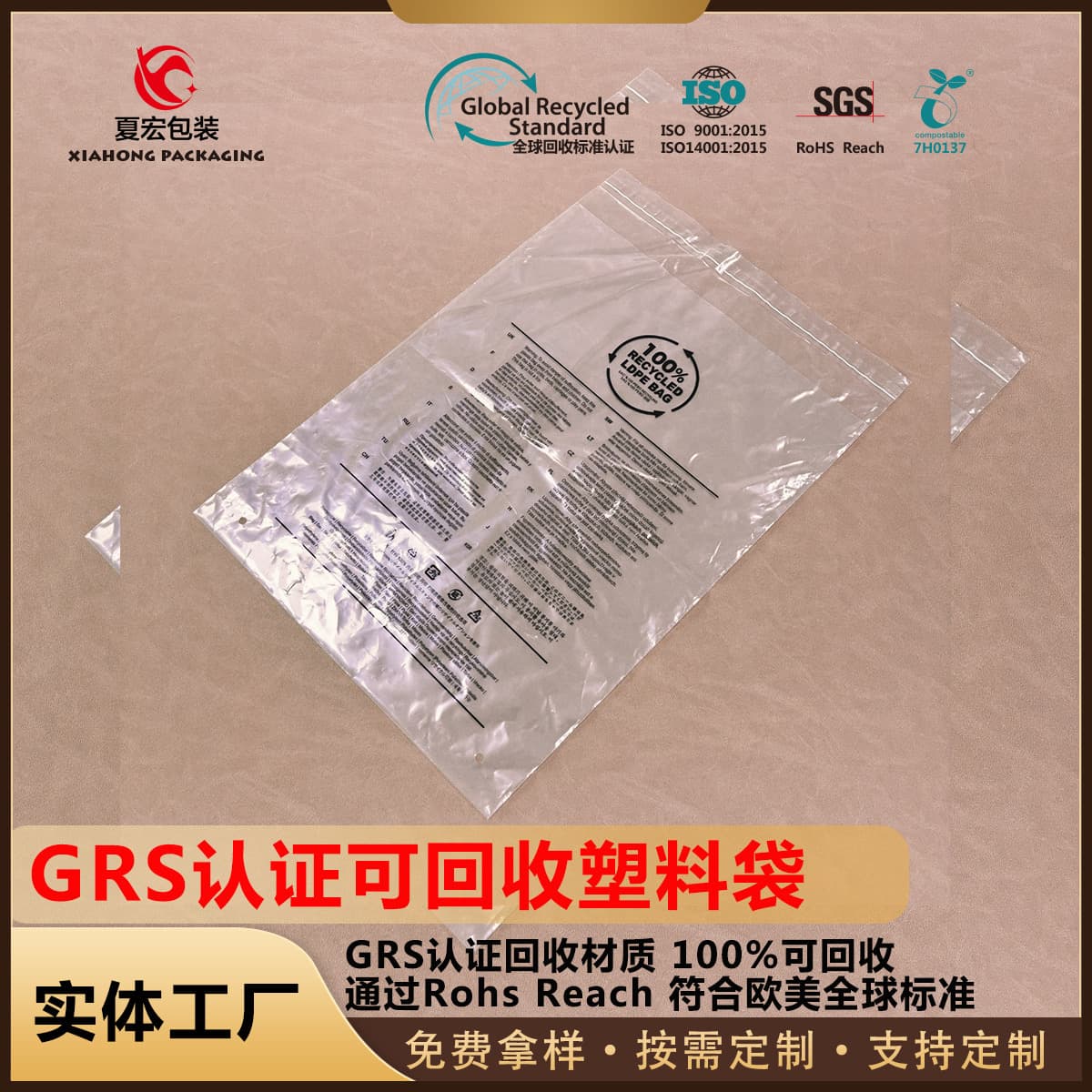
Xiahong Packaging's GRS/RCS certified recycled PE garment bags are built for exactly this file.
| Specification | Detail |
|---|---|
| Base material | Recycled LDPE / HDPE, 30–100% post-consumer content, specified per order |
| Formats | Open-end flat, self-adhesive, slider zipper, garment bag, dust cover |
| Thickness | 30–60 microns, tolerance ±10% on mean |
| Print | 1–6 colour flexography, water-based low-odour inks |
| System certs | GRS, RCS, ISO 9001, ISO 14001, Sedex |
| Shipment docs | Scope certificate, per-shipment TC support, heavy-metal reports, DoC file |
Where This File Pays for Itself
- Private-label knitwear and woven exports where the EU importer pre-approves bag specs
- Direct-to-consumer apparel brands printing recycled claims that must survive UK tax review
- Containerised garment programmes with specs locked by brand sustainability scorecards
- Retail hanging garment bags needing recycled declarations ahead of the 2030 thresholds
Quote Request Checklist
- State the target PCR percentage (30%, 50%, 70%, or 100%) and the Article 7 category.
- Ask for the Scope Certificate number and TE-ID; verify before sampling.
- Commit the supplier to applying for the TC within 30 days of shipment.
- Require TC fields to reconcile with your PO: seller, buyer, consignee, quantities, material percentage.
- Request component-level heavy-metal reports, not a generic compliance letter.
- Ask who drafts the Annex VII technical file and Annex VIII Declaration of Conformity.
- Confirm water-based inks and the print's heavy-metal profile.
- Fix thickness, size, and closure format with tolerance terms (±10% mean thickness is standard).
- Confirm MOQ, plate costs, and lead time for printed recycled film.
- Ask for EPR/PPT data support: batch weights, recycled proportions, document retention.
Related Product Solutions
- GRS Recycled PE Bags — certified recycled range overview
- GRS Certified Garment Poly Bag — open-end and self-adhesive formats
- GRS Certified Garment Zipper Bag — reusable slider closures
- 30% Recycled Zipper Bag with GRS — entry threshold for UK PPT exemption claims
- Custom Packaging Solutions — OEM programs from spec to shipment documentation
Why Xiahong Packaging
Founded in 2007, Xiamen Xiahong Plastic Products Co., Ltd. runs dual factories in Xiamen and Zhangzhou producing GRS/RCS certified recycled PE bags under ISO 9001 and ISO 14001 systems, with Sedex social audit coverage. Recycled content is traceable through the full certified chain, and every shipment ships with the certificates, test reports, and declarations European importers request.
Start the file at the purchase-order stage: send your specification and target PCR percentage, and Xiahong's team will return a sample plan and a documentation checklist matched to your destination market.