
Rigid Apparel Gift Box vs Soft Poly Bag: A Landed-Cost, DIM-Weight and EPR-Fee Decision Framework
Target audience: Apparel brand owners, e-commerce and DTC operations leads, packaging engineers, and procurement managers choosing between rigid gift boxes and poly bags on total landed cost — not unit price — while preparing for EU EPR fee escalation and the Packaging and Packaging Waste Regulation (PPWR) empty-space rules.
---
Why This Choice Got Harder in 2026
"Rigid box or poly bag" used to be a branding question. In 2026 it is a math problem, because three cost mechanisms price the decision directly:
- EPR fees differ sharply by material. Extended Producer Responsibility schemes in Europe and North America charge by weight and material, and the rates for plastic film and paper and board sit far apart. In 2026 euro-zone schemes, film pays roughly 1.75× to 78× the paper rate — Netherlands (Verpact) €17 vs €1,320/t; France (Citeo) €258 vs €770/t PE film; German dual systems average ~€0.26/kg paper vs €1.17/kg plastic.
- The EU PPWR (Regulation (EU) 2025/40) now applies, including its 50% void-space cap for online-shipping packaging — which penalises oversized boxes far more than soft bags that conform to the garment.
- Carriers bill air. Dimensional weight converts parcel volume into billable pounds, so a "cheap" rigid box can quietly multiply your freight line.
The right answer for most apparel assortments is both, deliberately split into a two-tier architecture — chosen with a landed-cost model, not a unit-price quote sheet.
---
Unit Price Is the Worst Number on the Quote
A printed poly mailer costs cents; a magnetic rigid box costs dollars — factory-direct references put a two-piece rigid box at USD 1.30–1.80 (500–1,000 pcs), against USD 0.08–0.35 for a mailer. That 10–30× gap decides nothing, because the box also changes four other cost lines:
| Cost line | Soft poly bag (Tier 1) | Rigid gift box (Tier 2) |
|---|---|---|
| Material per parcel | Low | High — board, wrap, magnets, insert, outer shipper |
| Packing labour | Garment in, seal, label | Assemble, insert, tissue, close outer carton |
| Freight basis | Usually actual weight | Often dimensional weight |
| Storage & inbound cube | Bags flat-stack | Boxes ship bulky or flat-pack plus assembly labour |
| EPR fee profile | Very light, but higher €/kg rate | Heavier, but lower €/kg rate for fibre |
| Damage & returns | Low for soft goods; risky for structured items | Protects shape, finish and perceived value |
Two of these lines — dimensional weight and EPR fees — deserve the spotlight, because each can invert the naive conclusion.
---
Dimensional Weight: The One-Inch Lesson
Carriers bill the greater of actual weight or dimensional weight (L × W × H ÷ carrier divisor). Under USPS Ground Advantage rules (DMM 283, 2026), parcels above one cubic foot (1,728 in³) divide by 139. For apparel:
- A poly mailer at 14 × 10 × 2 in = 280 in³ → billed at actual weight, ~1 lb.
- A box at 16 × 12 × 9 in = 1,728 in³ → still billed near actual weight, ~2.5 lb.
- The same box one inch taller (16 × 12 × 10 = 1,920 in³) → billed as 14 lb.
One inch of unnecessary height moved a 2.5-pound parcel into a 14-pound rate class. A soft bag conforms to the folded garment; a rigid box holds its shape — and its air — all the way to the carrier's scanner. The PPWR void-space cap points the same way: a presentation-sized box shipped as the outer parcel is exactly what fails the 50% empty-space test. Want the rigid presentation and the mailer's freight profile? Run the box as an inner tier inside a right-sized corrugated outer, or spec it to the garment's compressed dimensions, not its on-hanger dimensions.
---
The EPR Ledger: Expensive Kilos vs Heavy Kilos
Per-tonne rates flatter fibre — film pays multiples of paper in every euro-zone scheme examined for 2026. But EPR fees are charged on the weight you place on the market, so a 15–25 g mono-PE bag and a 400–600 g rigid box do not compare the way tonne rates suggest. Model per parcel, per destination market, with these specifics in your sheet:
- France (Citeo, 2026 tariff): clothing and textiles carry a per-unit fee of about EUR 0.0453 on top of material fees; Citeo counts the product's own packaging and the shipping carton as separate units.
- Germany (2026 dual-system averages): about €0.26/kg for paper and board against €1.17/kg for plastic. Since 1 January 2026 the ZSVR recyclability minimum standard pushes mono-material and fibre toward lower fees and poorly recyclable composites higher.
- PPWR eco-modulation is coming: Article 6(8) requires contributions to be modulated by recyclability grades A/B/C (≥95% / 80% / 70% recyclability) once the Commission adopts the delegated acts under Article 6(4)–(5), due 2028 and 2030. A mono-material GRS PE bag is the safer grade-A bet; fibre-rich rigid boxes with removable components and de-inkable wraps beat soft-touch + foil + foam hybrids.
The honest conclusion: the poly bag wins the per-parcel EPR line on sheer lightness; the rigid box wins the per-kilo rate and loses on every hardware element added to it. Strip the box to what the brand experience actually requires.
---
Running the Two-Tier Architecture
The economics favour splitting the assortment rather than picking one winner:
| Order / garment type | Recommended tier | Why |
|---|---|---|
| Tees, tanks, leggings, soft knits (1–2 units) | Tier 1 — GRS mono-PE garment bag | Actual-weight billing; lowest EPR per parcel |
| Hoodies, sweatshirts (1–2 units) | Tier 1, sized up | Still soft — check packed thickness against the 1 ft³ DIM trigger |
| Structured jackets, tailored pieces | Tier 2 inner + right-sized outer shipper | Creasing and shape loss justify the board |
| Hats, footwear, gift sets, premium drops | Tier 2 — rigid gift box in corrugated outer | Crush protection and presentation; compare against refund rate |
| Garments on hangers | Garment box / hanger carton | Flat-pack comparison almost always cheaper — test before defaulting |
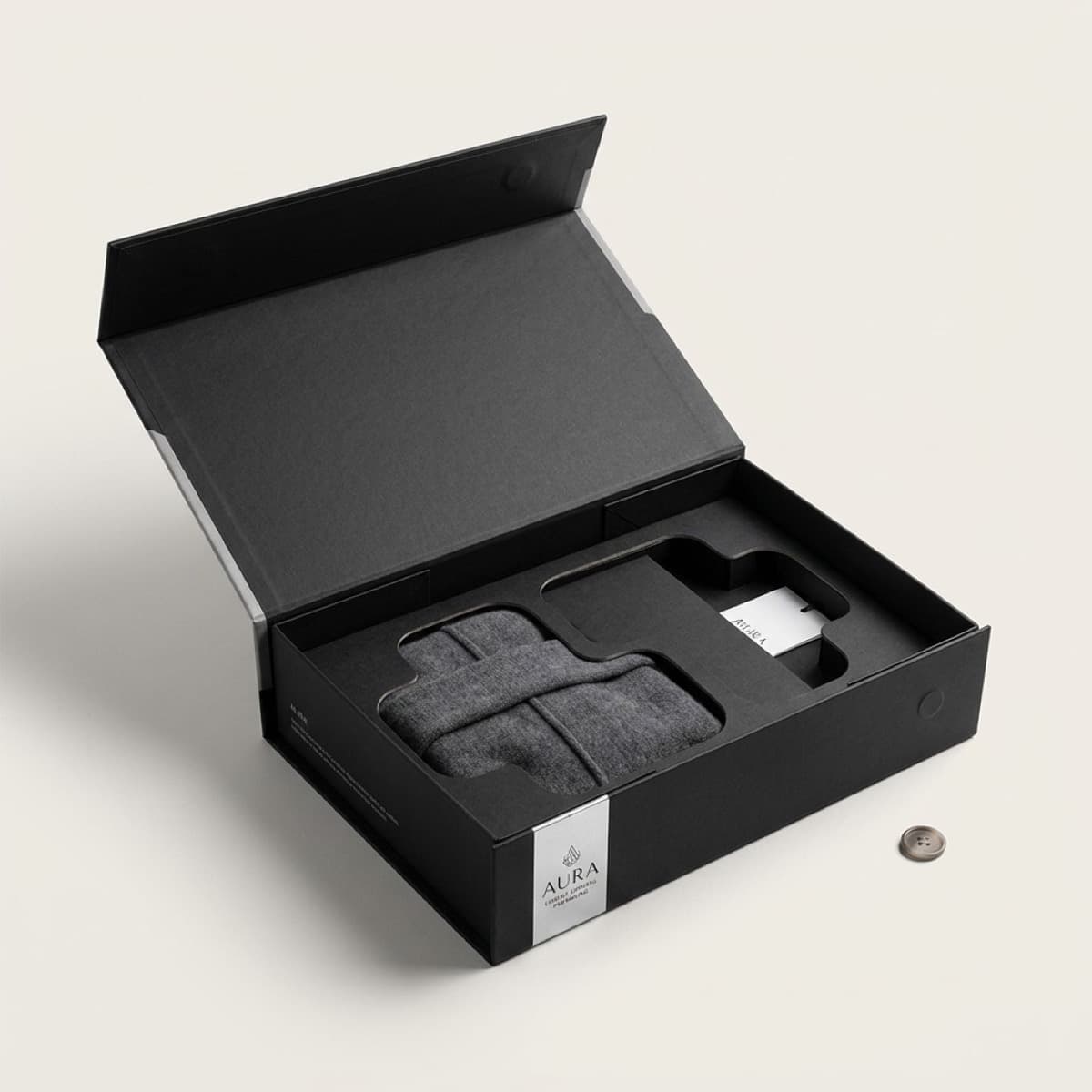
At Xiahong this maps to two production lines, not a compromise. The GRS Certified Garment Poly Bag runs 30–100% certified recycled LDPE with traceable scope and transaction certificates — a mono-material, grade-friendly Tier-1 outer. The Rigid Apparel Packaging Gift Box is greyboard construction with magnetic flip-top or lid-and-base structures, custom molded inserts, matte or soft-touch lamination, foil and spot UV, FSC-certified wrap on request — the Tier-2 presentation layer for gift sets and premium drops, sized to travel inside a right-sized corrugated shipper.
---
Key Specs to Lock Before Quoting
| Parameter | Poly bag (Tier 1) | Rigid box (Tier 2) |
|---|---|---|
| Material | Recycled LDPE, GRS 30–100% PCR, mono-material | 2–3 mm greyboard, printed wrap (FSC optional) |
| Typical size | 28 × 40 cm for tees up to 40 × 60 cm for outerwear | Built to compressed garment dims, e.g. 33 × 25 × 8 cm |
| Closure & features | Self-adhesive flap, re-sealable zip option, market-specific warning text | Magnetic flip-top or lid & base, ribbon pulls, fitted insert |
| Printing | Up to 10-colour gravure | Litho-laminated wrap; foil, spot UV, embossing |
| MOQ reference | 5,000–10,000 pcs | From 500 pcs; price breaks sharpen at 1,000 and 5,000 |
| Compliance file | GRS scope + transaction certificates, REACH/RoHS | FSC chain of custody, heavy-metal report for board and inks |
---
Quote Checklist
- A per-parcel landed-cost model: top five SKUs, both tiers, each destination market — material + packing labour + freight basis + EPR fees at published rates.
- Box dimensions cut to the compressed garment, with the void-space ratio on the spec sheet so PPWR compliance is auditable.
- Mono-material construction wherever the rule allows; removable magnets and fibre-based inserts where presentation needs them.
- Certificate chain: GRS scope and transaction certificates for recycled PE; FSC claim plus de-inkability expectations for the wrap.
- Quantity-tier quotes at 500 / 1,000 / 5,000 for Tier 2, planned around six months of usage rather than one seasonal drop.
---
Related Pages
- GRS Certified Garment Poly Bag — https://www.chinapolybags.com/catalog/grs-garment-poly-bag
- Rigid Apparel Packaging Gift Box — https://www.chinapolybags.com/catalog/rigid-apparel-packaging-gift-box
- GRS Recycled PE Bags range — https://www.chinapolybags.com/products/grs-recycled-pe-bags
- Paper Bags & Boxes — https://www.chinapolybags.com/products/paper-packaging
- Color-Printed Airplane Mailer Box — https://www.chinapolybags.com/catalog/color-printed-apparel-airplane-mailer-box
- Solutions — https://www.chinapolybags.com/solutions
---
Get a Two-Tier Cost Model
Send your SKU list, packed dimensions and target markets. The Xiahong team returns a side-by-side landed-cost comparison for both tiers (bag, box, freight basis, EPR estimate at published rates) within two business days. Dual factories in Xiamen and Zhangzhou; ISO9001, ISO14001, GRS, Sedex and FSC certified; OEM to export brands since 2007.
Figures are published carrier rules and 2026 market-average reference prices; verify against your own rate cards and scheme invoices.